The daily check-in
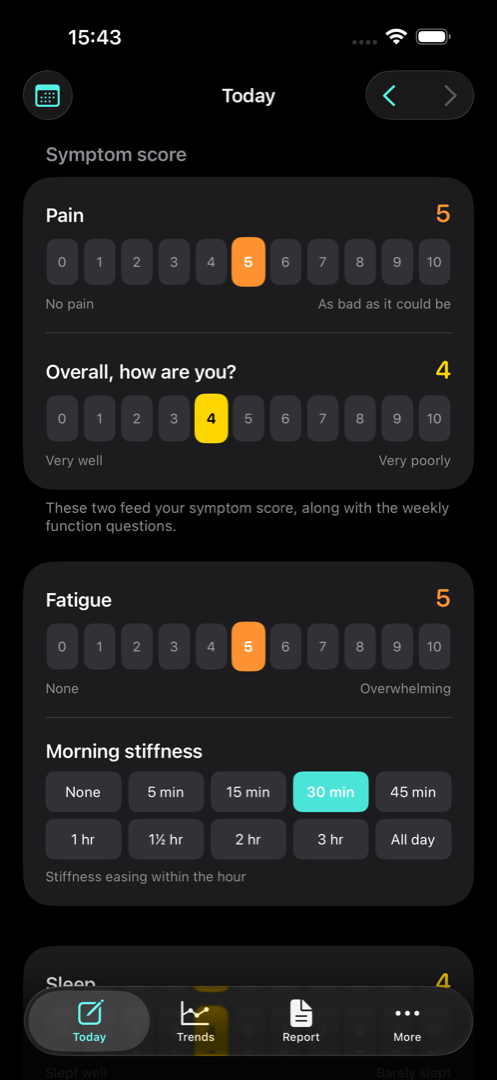
Pain, overall status, fatigue, morning stiffness, sleep and mood — each a single tap, with a switch for flare days. Under a minute, by design.
 JointSignal
For rheumatoid arthritis. Only rheumatoid arthritis.
Most trackers cover a dozen conditions passably. JointSignal is built for RA and nothing else — a minute a day becomes objective patterns your rheumatologist can act on: not how you feel in the waiting room, but how you have actually been since they last saw you.
Requires iOS 18 or later.
Everything a rheumatologist asks about, and nothing that exists for some other condition. Screens below are from the app, unretouched.
Pain, overall status, fatigue, morning stiffness, sleep and mood — each a single tap, with a switch for flare days. Under a minute, by design.
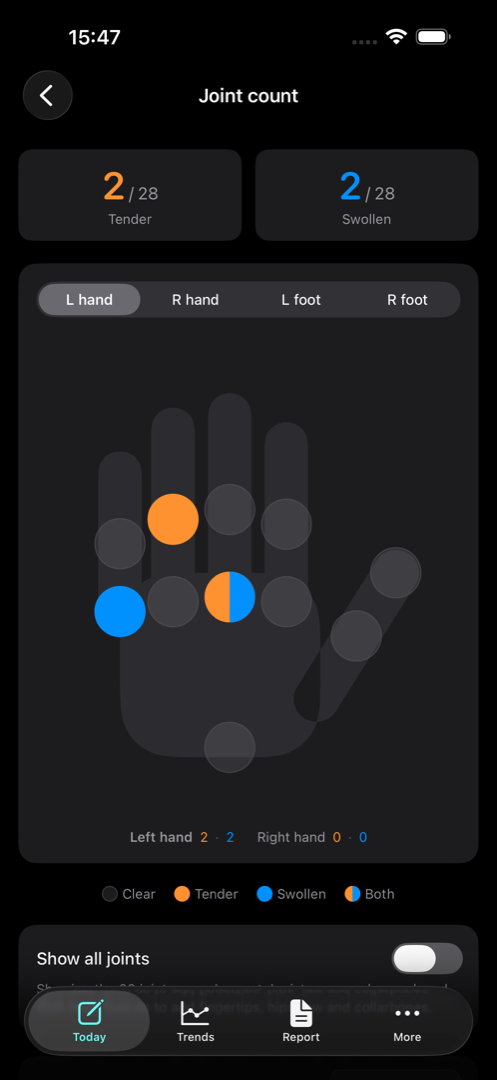
Every joint your rheumatologist scores, including the fingers, with tap targets built for hands with active RA. Tender, swollen, or both.
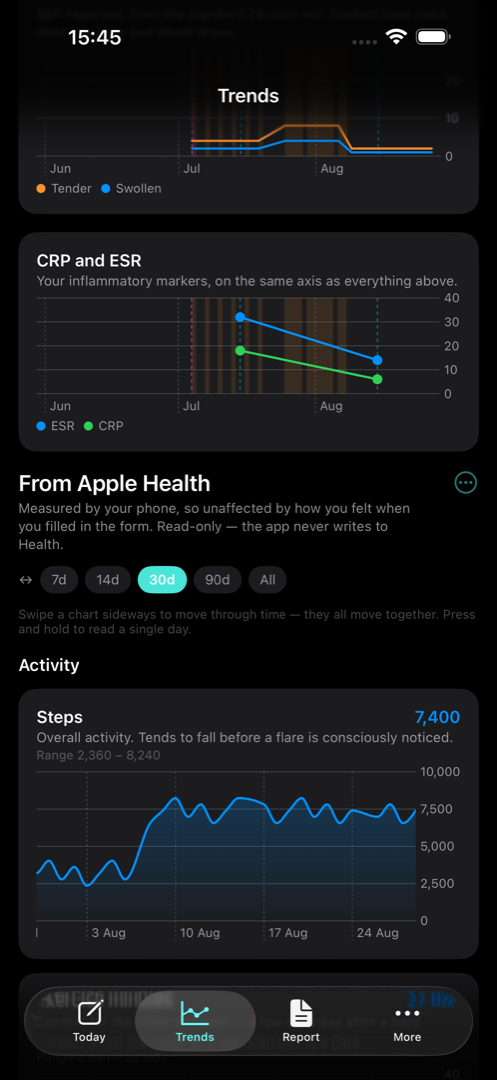
Steps, walking speed, sleep and heart rate sit under what you reported, on one shared axis — measured by your phone, so unaffected by how you felt that day. The app never writes to Health.
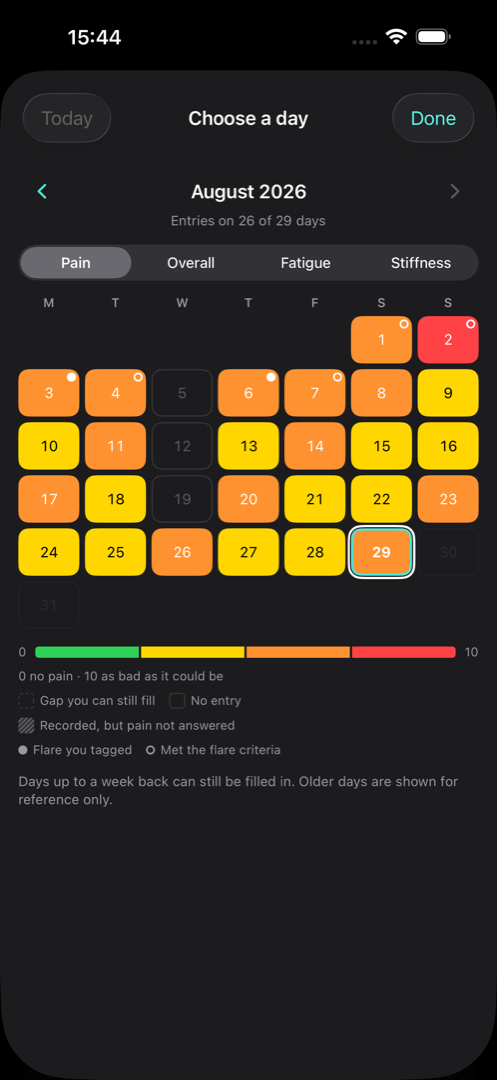
Every day coloured by how bad it was, flares marked, and gaps shown as gaps — the view that shows whether the days you missed were also the worst ones.
Your regimen, dose by dose, with the history beside your symptoms and dose changes marked on every chart. A dose you never answered is excluded from the percentage, not counted as missed.
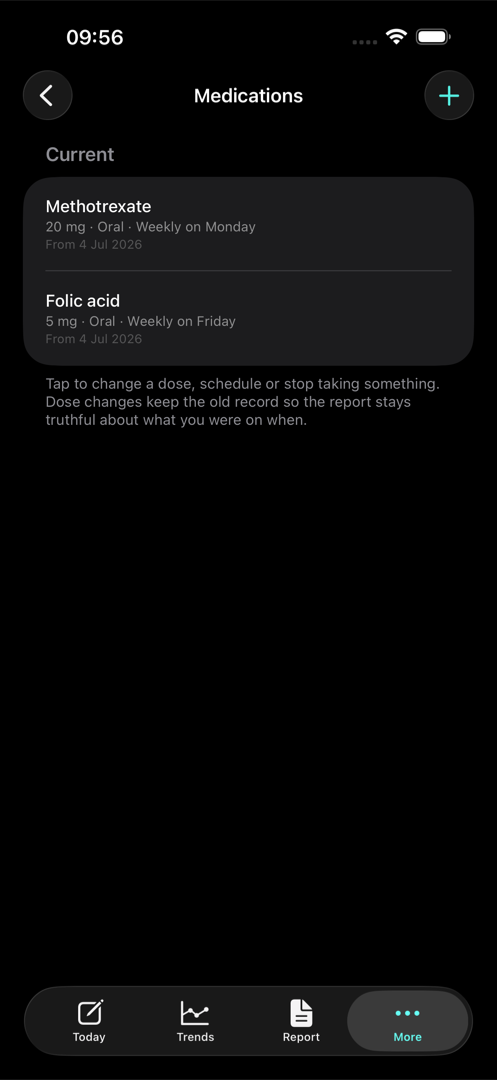
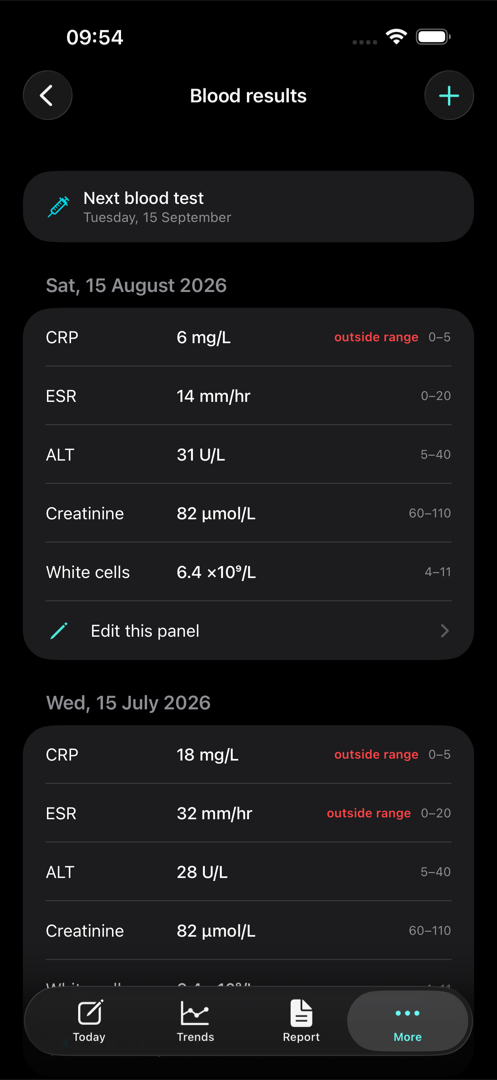
CRP, ESR and the rest of your panel, entered once and charted with everything else — plus appointment and blood-test reminders so a draw never gets missed before a review.
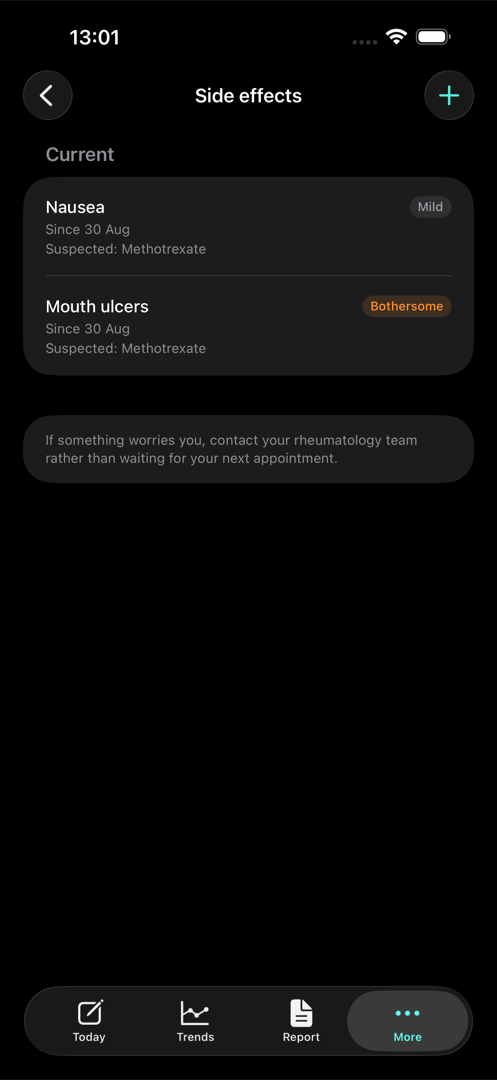
Record a side effect, when it started, whether it has settled, and which medicine you suspect — recorded as a suspicion. Timing against your doses is stated as counts, never as cause.
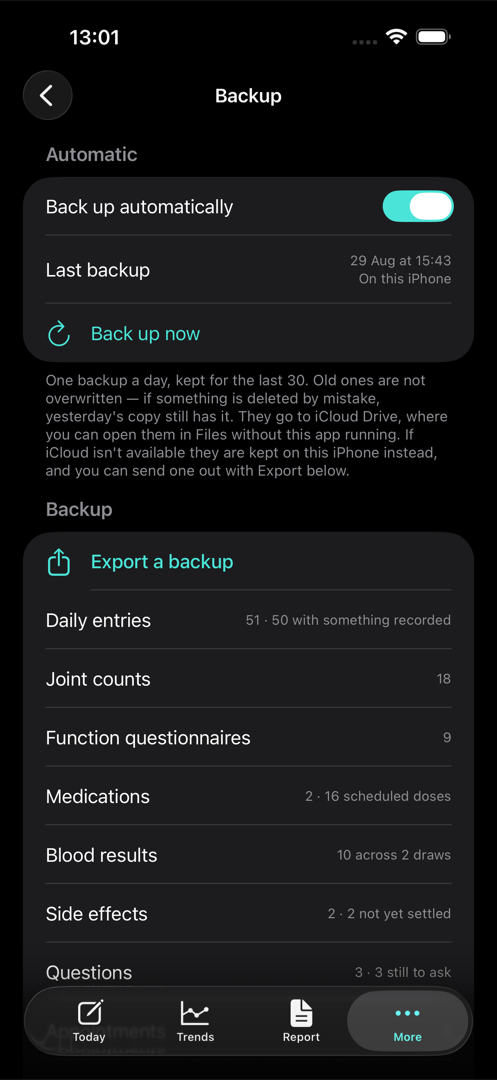
A dated backup a day to your own iCloud Drive, thirty kept and never overwritten. Export the whole record whenever you like. There is no server to lose it and no account to be locked out of.
The report
RA is treated to a target: you and your rheumatologist agree where you are trying to get, and adjust treatment until you are there. That only works if they can see how you have actually been between visits — and a fifteen-minute appointment leans almost entirely on what you can remember. JointSignal turns a minute a day into data they can act on.
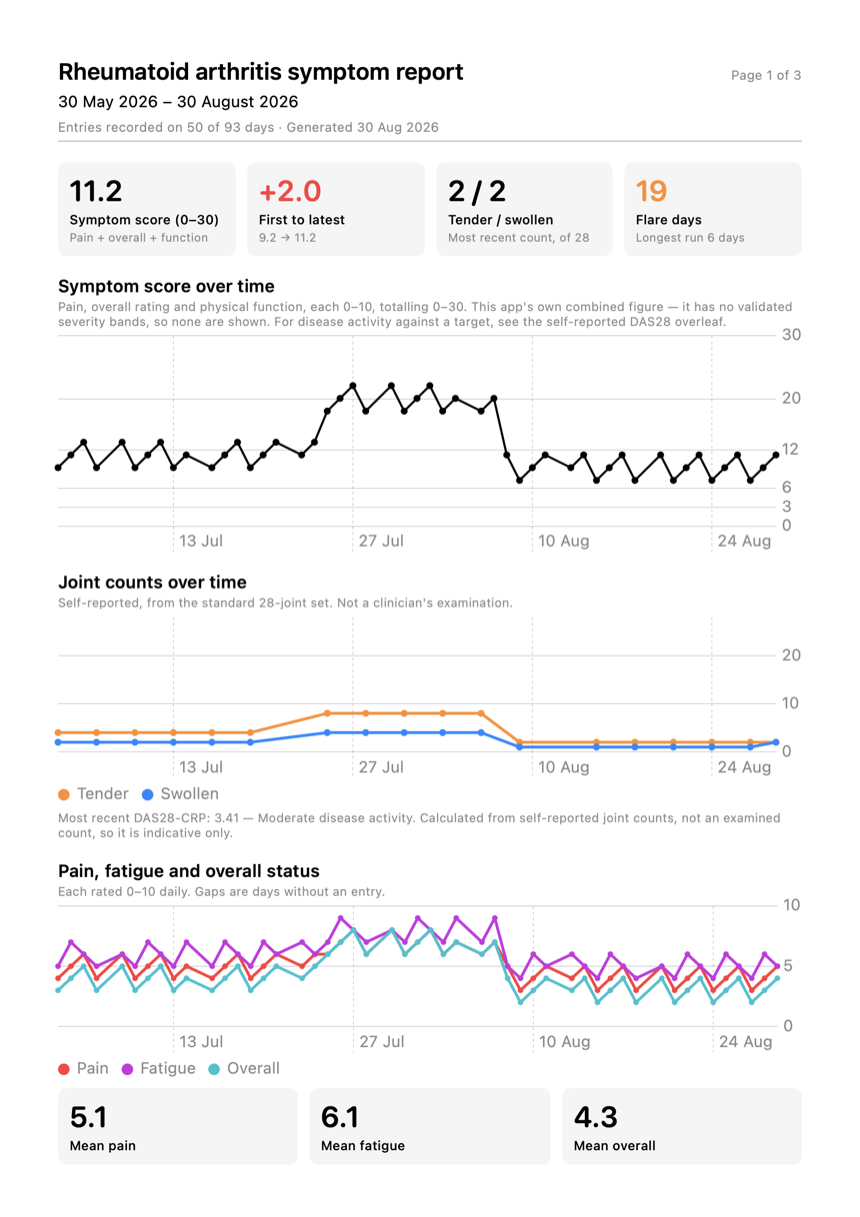
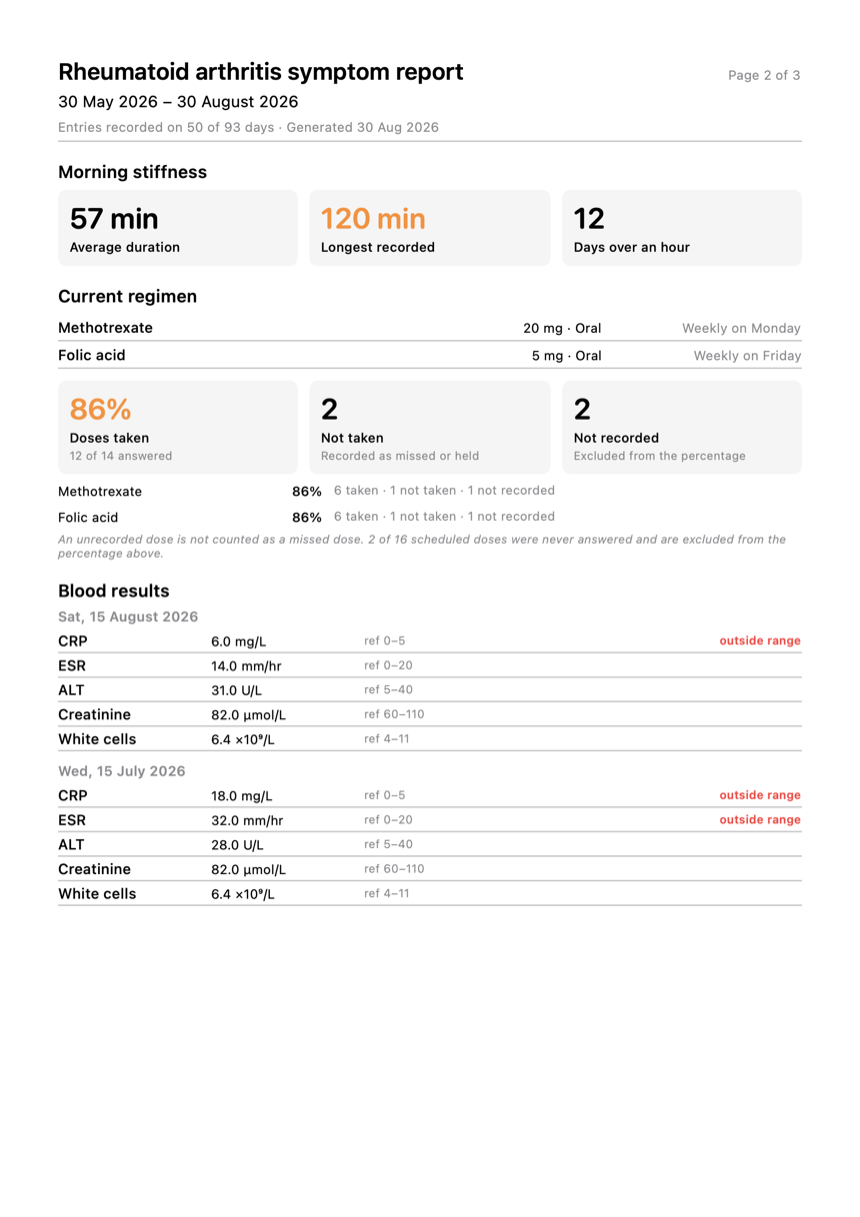
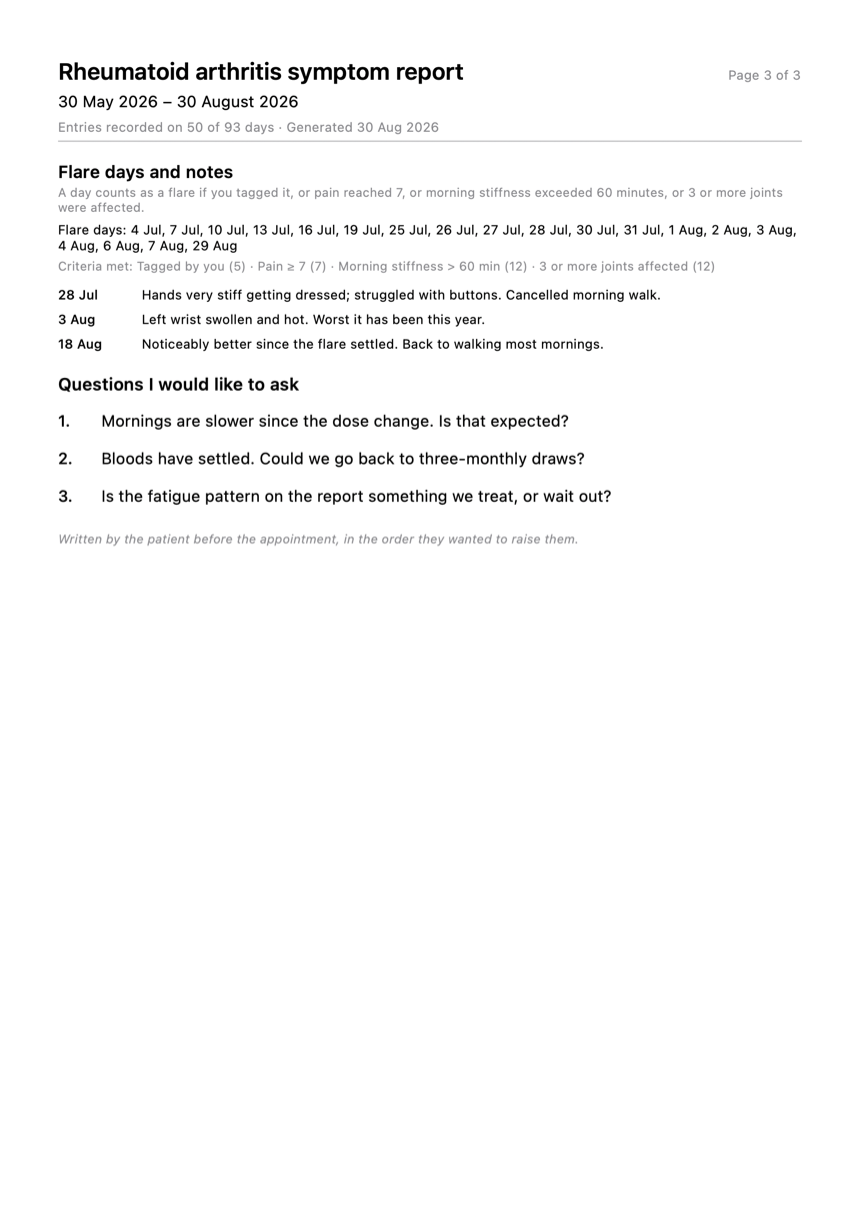
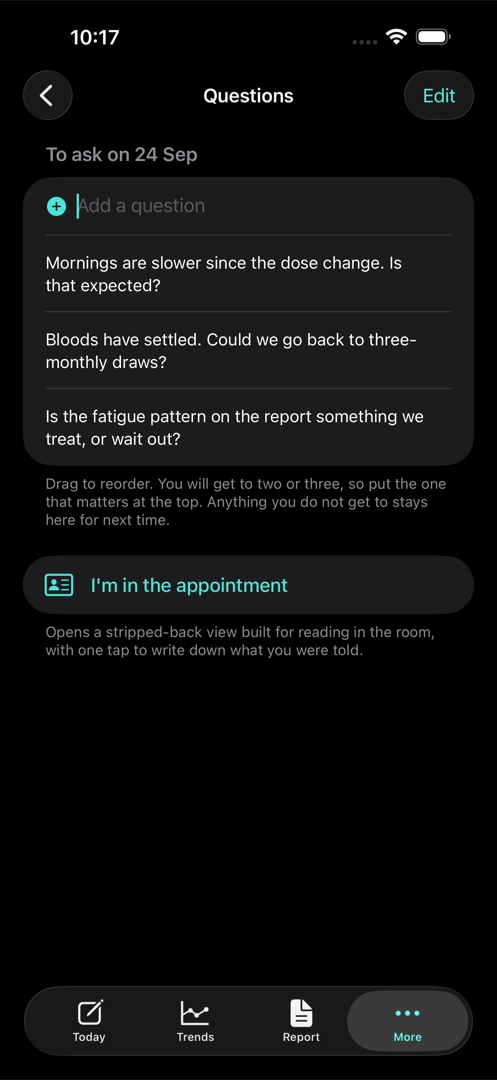
The moment a question occurs to you is never the moment you are in the room. Save questions as they come, put the one that matters at the top, and they print on the report — so the appointment covers what you actually wanted to raise.
Export the PDF for any date range and email it ahead, AirDrop it at reception, or just hand your phone across the desk.
Read the guide: preparing for a rheumatology appointmentOne rule that doesn't bend
A question you didn't answer stays unanswered. It never quietly becomes a zero, and a day you missed never appears on a chart as a good day. A report is only useful to a clinician if everything on it is something you actually said.
I'm Scott. I have rheumatoid arthritis, and I use JointSignal every single day — the same app you can download, not a demo — to manage it alongside my own rheumatologist.
I went looking for an app that would let me track RA properly and could not find one. The apps I tried covered several conditions passably rather than one condition well. One left the finger joints out of its joint count, which is a strange omission for an arthritis app. None of them read Apple Health, so the thing my phone already measured all day sat in a separate app from the thing I was typing in every evening. I was paying a subscription for that.
The bigger problem was what those apps thought tracking was for. RA is managed with your rheumatologist, not around them. Appointments are short, they happen a few times a year, and the decisions made in them lean almost entirely on what you can report about the months in between. What helps is the pattern, not the impression — how long the stiffness really lasts in the morning, which joints have been swollen and when, what the fatigue has done over weeks, when the flares came, what you were taking and whether you actually took it.
So I built the app around the appointment: a check-in fast enough to do every day, a record honest enough to hand over, and a report a rheumatologist can read in a minute.
And JointSignal is not a company. It is just me, in Christchurch, New Zealand, building the thing I needed — made with care, with far more hours in it than a subscription will ever pay back. The subscription covers the costs of operating the app and keeping it maintained, and your data is worth nothing to me because I never receive it. I'm one person on the same road as you, walking alongside everyone else living with RA, hoping the thing that helps me helps you.
The whole app, no tiers. A tracker that withholds your own joint count behind an upgrade is not a tracker.
NZ$69.99 a year
or NZ$6.99 a month
Your first two months are free.
If your subscription ends, you keep full access to read and export everything you recorded. Your history is never held to ransom against a payment.
No. JointSignal doesn't diagnose anything and it isn't medical advice. It records what you tell it and shows you the patterns. Your rheumatologist does the rest. Never delay seeking medical attention because of something this app did or did not show you.
The costs of running the app and keeping it alive. Your data never touches a server — but an app still costs real money and real time to keep going: the domain and website, the developer account, and the ongoing work of new features, security updates, keeping up with each new version of iOS, responding to what people report, and building what is missing. Paying regularly is what makes that an obligation rather than a hobby.
You keep it, and you keep full access to read and export all of it. Locking someone out of their own symptom history would contradict the rule the whole app is built on.
Pain, overall status and physical function, each 0–10, totalling 0–30. It is the app's own combined figure and it deliberately has no severity bands — those belong to validated instruments, and the function questions here are the app's own plain-language set. Use it as a trend line: is it going up or down.
Yes, from your self-reported joint counts, and it is labelled self-reported everywhere it appears. DAS28 has published cut-points, so disease activity against a target is reported through it rather than through the app's own figure. It is not a substitute for your rheumatologist examining your joints.
Within the last week, yes — and the report marks those entries as filled in after the day. Beyond a week the day is read-only. A pain score recalled from further back is a guess, and this app treats a gap as more honest than a guess.
Rheumatoid arthritis. One condition, properly, rather than several passably. If you live with a different form of arthritis, this is honestly not the app for you — and that focus is exactly what makes it the right one if you live with RA.
Not currently. Everything lives on one phone, backed up to your own iCloud Drive. Syncing between devices is a genuinely difficult problem to solve without risking the accuracy of your record, and it will not ship until it can be done without that risk.
No, and there is unlikely to be one. The Apple Health integration is a large part of what the app does.